
Can optimising AEX loading conditions and resin selection improve plasmid DNA recovery, RNA clearance and purification efficiency?
By Carola Schröder at Richter BioLogics
The demand for clinical good manufacturing process grade plasmid DNA (pDNA) has grown substantially due to its key role in next generation vaccines and therapies. It acts as an active pharmaceutical ingredient (API) in DNA vaccines or cell and gene therapies, as critical raw material in the production of viral vectors, and as template for therapeutic mRNA. Meeting this demand requires robust and efficient processes for pDNA manufacturing. Purification of pDNA from bacterial lysates is challenging due to the presence of structurally similar host-impurities such as Ribonucleic acid (RNA) and genomic DNA (gDNA), as well as different plasmid isoforms (Figure 1).1 The enrichment of the covalently closed circular (ccc) form is particularly relevant, as it is typically associated with higher biological activity.
pDNA production by contract development and manufacturing (CDMO)
Several pDNA production and purification strategies have been established and CDMO business is to provide high pDNA yields of high quality. A typical pDNA production process is divided into three-unit operations: upstream (E. coli fermentation and harvest), midstream (cell lysis and clarification) and downstream processing (pDNA purification), commonly shortened to USP, MSP and DSP. Richter BioLogics has established its own proprietary pDNA production and purification process called pART platform. The DSP of the pART process starts with an anion exchange chromatography (AEX) step. AEX resins are commonly applied for pDNA purification due to their reliable binding capacity of nucleic acids. This capture step is often followed by an additional polishing step, most commonly hydrophobic interaction chromatography, to further improve purity by depleting undesired product isoforms. In constant pursuit of further optimising process robustness and yield enhancement with preservation of high purity, effort is continually invested to improve overall process performance and test new technologies.
In this article, results from a recent capture chromatography (AEX) study are shown. High AEX loading capacities are of particular importance, as they directly impact process productivity and overall manufacturing efficiency. If sufficient purity is already achieved during the AEX step, the need for additional downstream processing steps may be reduced, enabling simplified process designs and, in some cases, single-step purification strategies. AEX chromatography provides a scalable and robust purification approach with several different support types available.2 However, chromatographic performance depends strongly on process parameters such as loading, gradient design and elution pool criteria, which influence yield and impurity clearance at the same time. This study investigates the impact of pDNA quantity loaded per resin volume on the yield and RNA removal during pDNA purification.
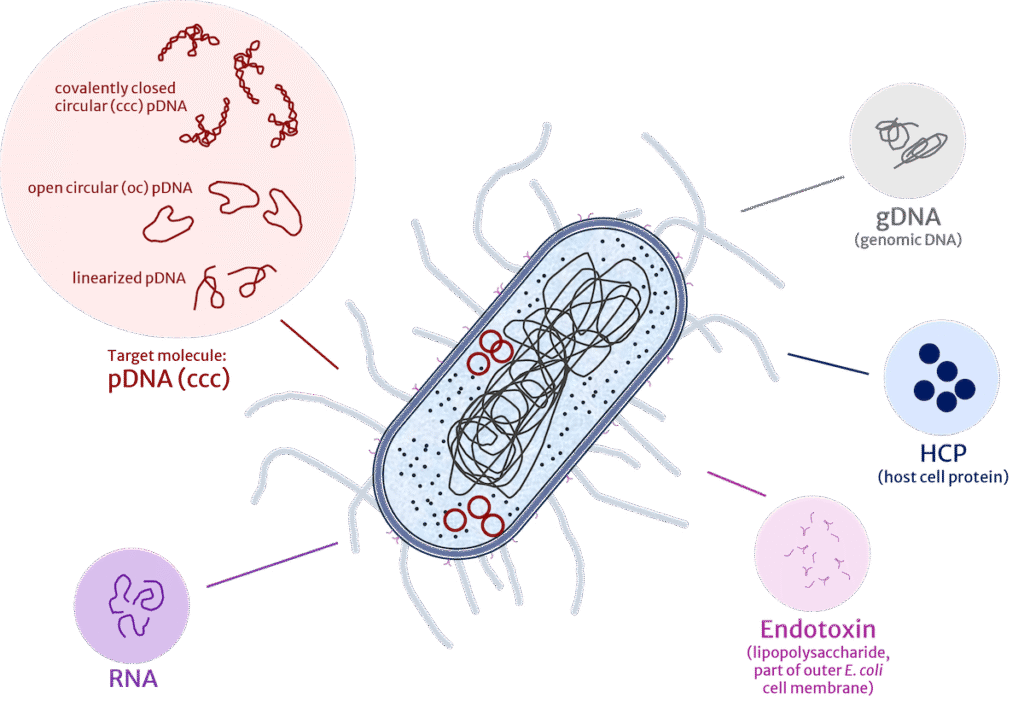
Figure 1: Sketched E. coli cell as pDNA production host with typical impurities, such as gDNA, host cell protein, endotoxin and RNA. Plasmid isoforms, such as open circular or linearised forms, are separated from the biologically more active ccc pDNA form
AEX loading study on two different resins
Richter BioLogics’ model plasmid (5.7kb) was used to investigate loading capabilities, step yield and remaining RNA in the elution fraction on different AEX resins using a generic capture method. The results of the two best performing resins during the given experimental setup are presented in the following. Specific loadings of 0.5 and 1.1gpDNA/Lresin were used to investigate low loading conditions, 2.5-2.8gpDNA/Lresin were used as intermediate loading conditions and 4.7gpDNA/Lresin as high loading approach (Figure 2). Resin 1 showed constant step yields, relatively independent from loading conditions. Resin 2 showed a slightly stronger dependence on loading. While slightly lower yields were observed at low loading, yield increased at higher specific loadings, where the highest recovery was obtained. More pronounced responses to loading conditions were observed by remaining RNA portions (Figure 2). RNA level decreased with increase of specific loading. Resin 2 showed lower RNA carry-over level in general with almost no RNA left at the highest tested loading condition.
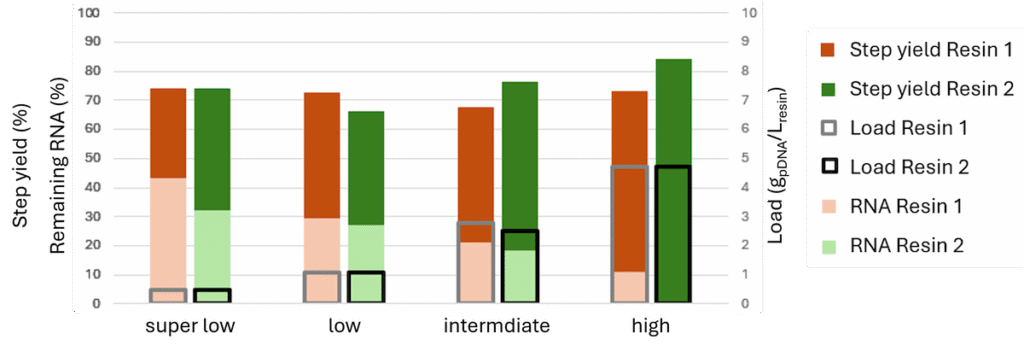
Figure 2: Step yield and residual RNA proportions as a function of loading for two AEX resins. Step yield (%) and remaining RNA (%) are shown on the primary y-axis, while the corresponding loading (pDNA/Lresin) is indicated on the secondary y-axis
The agarose gel picture of the high loading condition experiment confirmed the higher loading capability (absence of product in flow through) of resin 2 and additionally the reduced RNA presence in the elution fractions. Accordingly, targeting high loading conditions is beneficial for product recovery and purity under the given experimental setup for the model plasmid especially in combination with resin 2.
This study shows that loading conditions may have an impact on step yield and RNA removal in anion exchange chromatography. Some resin-specific behaviour was shown, especially with high loading capacity and RNA removal at such. These results suggest that AEX operation under high loading conditions may offer advantages in terms of productivity and product quality. Hence, defined loading conditions and an appropriate resin system may lead to yield and purity enhancement.
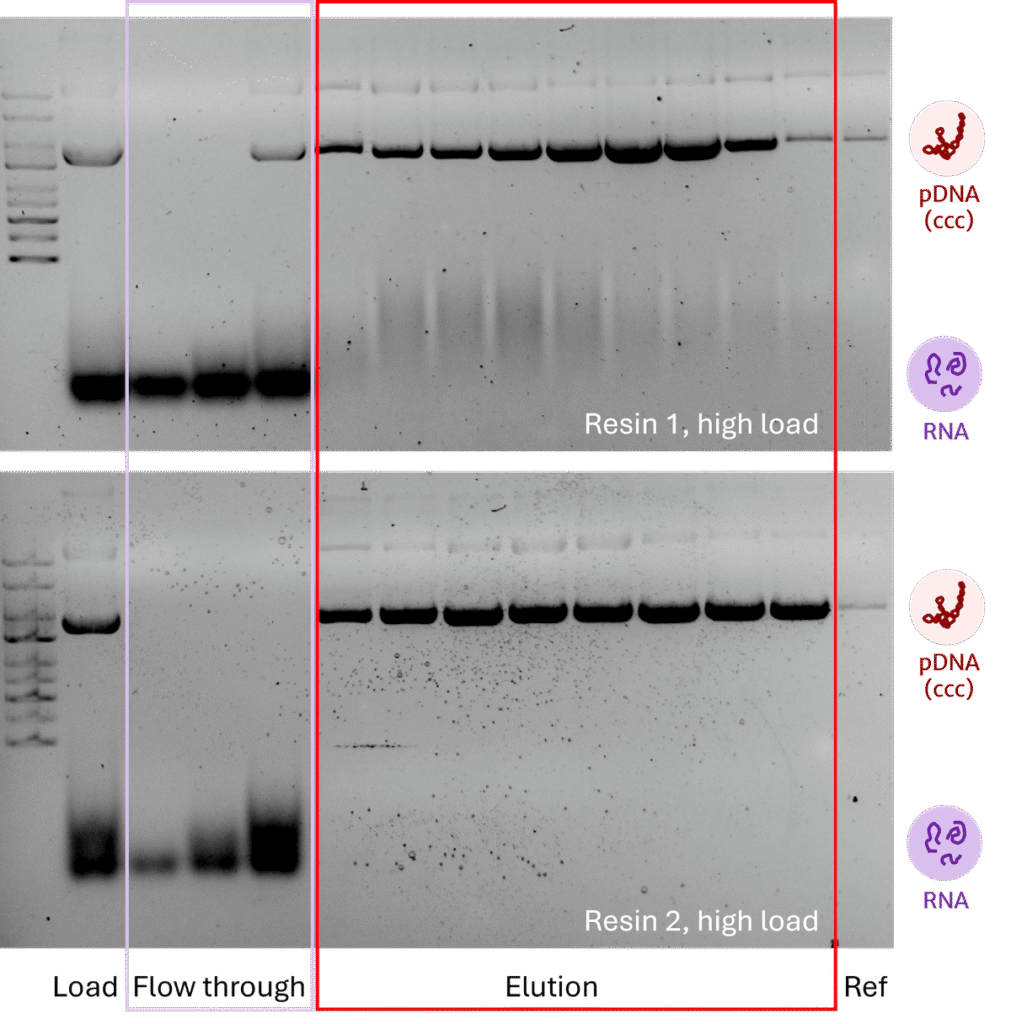
Figure 3: Agarose gel pictures of load, flow through and elution fractions from AEX with resin 1 (shown above) and resin 2 (shown below). A plasmid reference is shown in the last lane (Ref ). Fractions were collected widely distributed within the respective UV260nm peak. pDNA is predominantly detected in the elution fractions, with a distinct band corresponding to the ccc form. RNA is largely depleted in the flow through fractions
References:
- Visit: doi.org/10.1016/j.aca.2018.04.001
- Visit: doi.org/10.1016/j.chroma.2020.461848
Link to magazine:
https://www.samedanltd.com/european-biopharmaceutical-review/
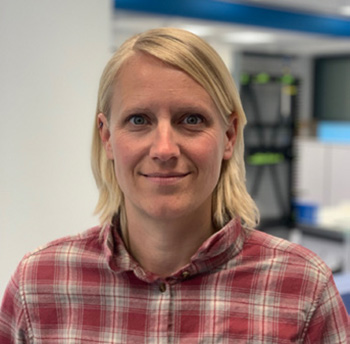
Carola Schröder is team leader downstream process development at Richter BioLogics. She holds a PhD in Biology and, following several years as a postdoctoral researcher at the Hamburg University of Technology, Germany, she joined the biopharmaceutical industry as a scientist. In her current role, she leads downstream process development activities across a diverse project portfolio, supporting modalities including plasmid DNA, proteins, peptides, polysaccharides and conjugates.